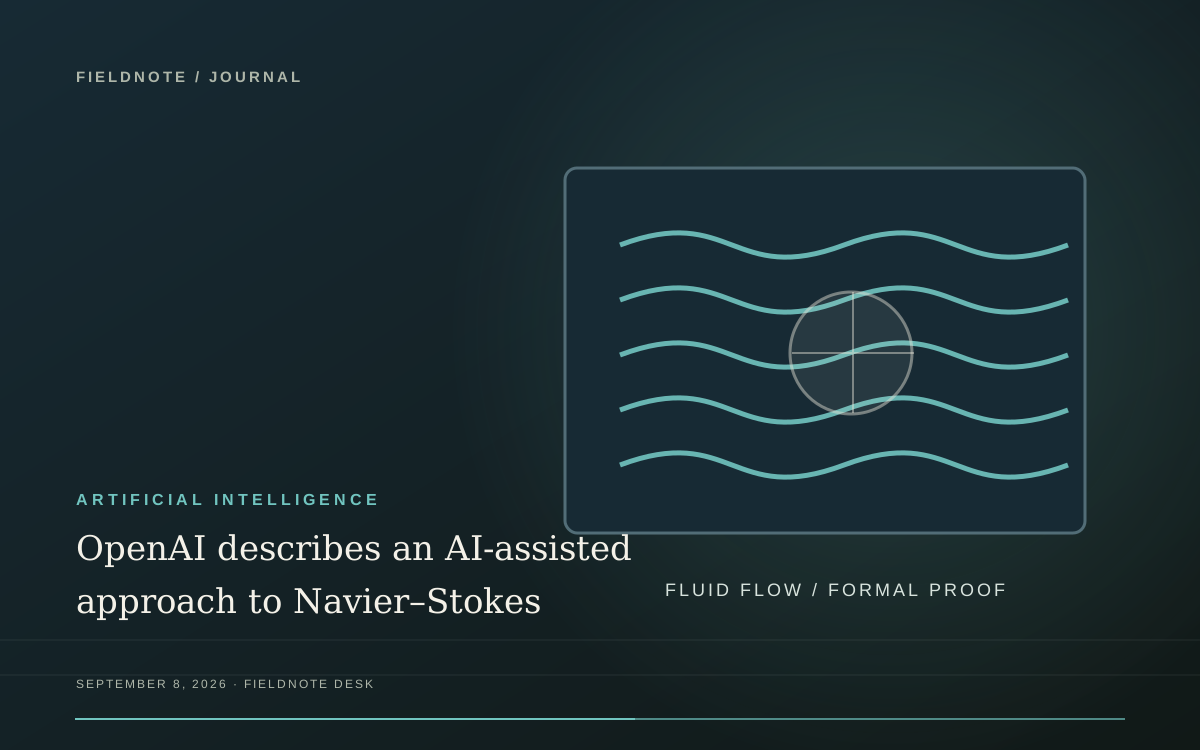
OpenAI’s September 8 research post describes a system of coordinated agents that produced a proposed solution related to the Navier–Stokes problem. The company says the proof was formally checked. The post frames the work as a research result and does not claim that the Millennium Prize problem has been solved.
That distinction matters. Formal verification can check that a proof follows from its stated assumptions, but the wider mathematical community still has to assess whether the argument addresses the exact problem and whether the result stands up to scrutiny. AI’s contribution is an important research signal, not a shortcut around expert review.
A tool for exploration, not a final verdict
The episode points to a possible new workflow: models generate candidate approaches, specialized tools check formal steps, and researchers evaluate whether the result is meaningful. Each stage has its own failure modes. A machine-checked derivation can still depend on definitions or assumptions that require careful interpretation.
What mathematicians will examine
The central questions are whether the proposed result matches the recognized statement of the problem, how much of the reasoning was independently reproduced and what the process reveals about AI-assisted discovery. OpenAI’s own description should be treated as a starting point for that conversation, rather than a declaration of consensus.